X-ray experiment delivers direct evidence for a third form of magnetism
A SLAC-led team used polarized X-rays at a French synchrotron to detect a telltale "handedness" in the magnetic structure of manganese telluride, providing what researchers call the clearest proof yet that altermagnetism — a proposed hybrid of ferromagnetism and antiferromagnetism — is a genuine, distinct phase of matter.
For nearly a century, physicists have sorted magnetic materials into two tidy categories. Ferromagnets, the kind that stick to a refrigerator door, have electron spins that all point the same way, producing a magnetic field anyone can detect. Antiferromagnets, discovered in 1933, have spins that alternate up and down and cancel out, leaving no net field at all. A team led by the Department of Energy's SLAC National Accelerator Laboratory now says it has direct experimental proof of a third option, one that behaves like both at once.
The findings, published October 29 in the journal Science, describe X-ray measurements on manganese telluride, a compound long classified as an ordinary antiferromagnet. The team detected a distinct "handedness," or chirality, in the material's magnetic structure that conventional antiferromagnetism cannot produce. Researchers say the result is the clearest evidence yet that altermagnetism, a magnetic phase first proposed in 2022, is a real and distinct state of matter rather than a theoretical curiosity.
A gap in a 90-year-old picture
The two-category model of magnetism held up for decades because it matched what instruments could measure. But in recent years, researchers working at X-ray and neutron facilities around the world kept finding materials that didn't fit cleanly into either box: compounds with the zero net magnetization typical of antiferromagnets, yet capable of carrying spin currents, an ability usually associated with ferromagnets. Those two behaviors had been treated as mutually exclusive since the 1930s, so each new ambiguous material was initially explained away as a measurement artifact or an unusual antiferromagnet.
In 2022, a group of theorists gave this unruly class a name, altermagnets, and proposed that the effect arises from a subtle geometric twist in the crystal lattice itself. Spins alternate up and down as in an antiferromagnet, but the lattice surrounding the "up" spins is rotated relative to the lattice around the "down" spins, a symmetry-breaking detail invisible to most measurement techniques. The proposal reorganized a period of scattered, hard-to-interpret results into a single testable prediction, which is what made manganese telluride, long filed away as an unremarkable antiferromagnet, worth revisiting.
"In the past few years, scientists have observed phenomena that don't fit neatly into the ferromagnetism-antiferromagnetism dichotomy," said Daniel Jost, the study's lead author and an associate scientist at SLAC and the Stanford Institute for Materials and Energy Sciences. Researchers had been accumulating indirect evidence for years, he said, but lacked a measurement that could rule out every alternative explanation.
Chasing a telltale twist
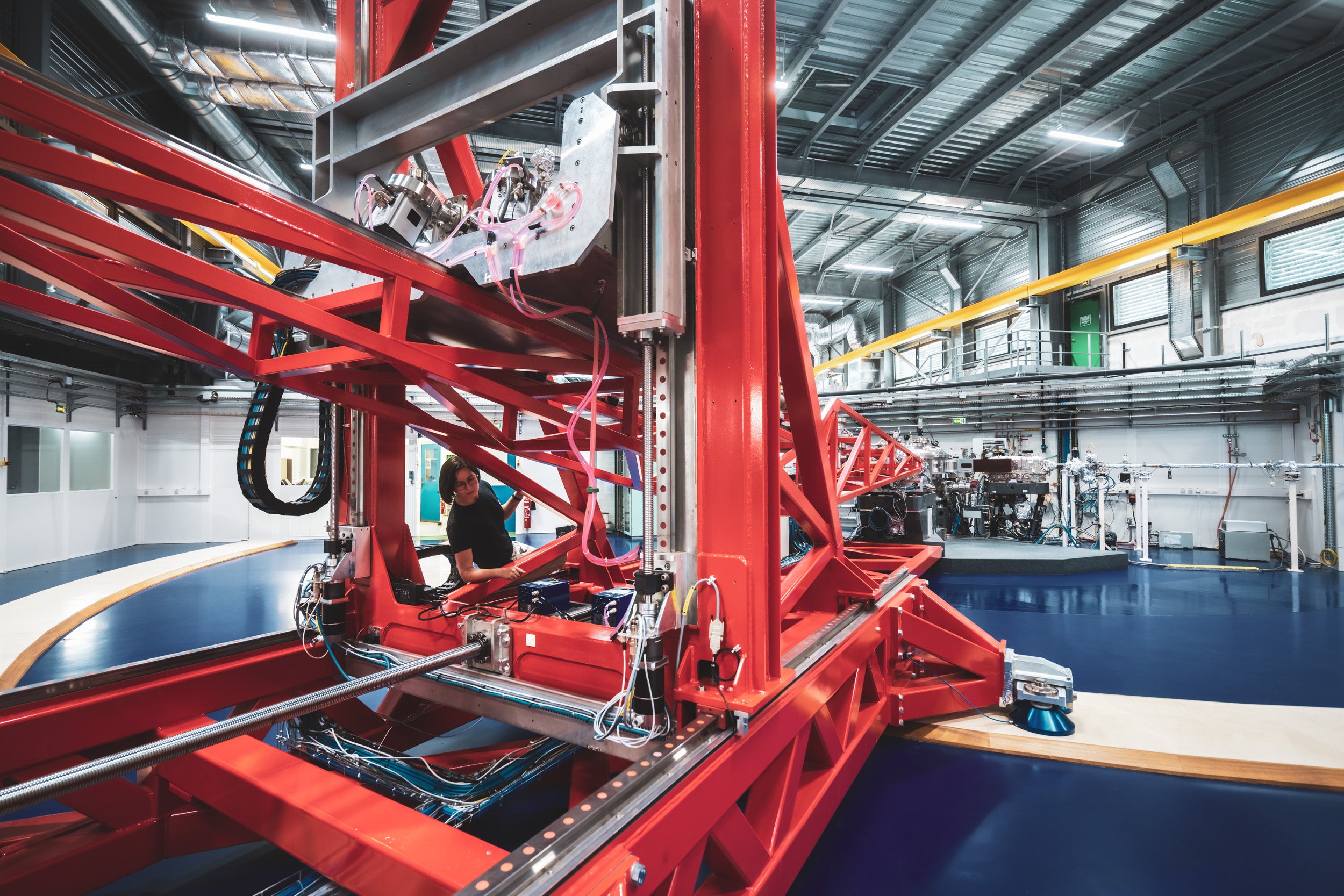
That missing measurement was chirality. A chiral object, like a hand, cannot be superimposed on its own mirror image. Jost's team reasoned that if altermagnetism were real, manganese telluride's magnetic and electronic structure should scatter left-circularly polarized X-rays differently than right-circularly polarized ones, a signature a conventional antiferromagnet should not produce. The group brought samples to the European Synchrotron Radiation Facility, a multinational research campus in Grenoble, France, backed by 19 partner countries and home to 46 separate beamlines. Its ID32 beamline is built specifically to generate tightly controlled, circularly polarized X-ray beams, which the team used to probe the material's electronic and magnetic structure at a resolution that laboratory-scale X-ray sources cannot match.
The team found a clear chiral signal where a conventional antiferromagnet should have shown none. An initial experiment in 2024 was repeated in early 2025 with consistent results, and the group spent the months that followed ruling out instrumental artifacts and alternative explanations before submitting the work for publication.
"We believe our results provide robust experimental confirmation that this third phase – altermagnetism – is real."
"This chiral signature gave us the solid experimental ground to say altermagnetism stands in a class of its own," Jost said. Rachel Nickel, a postdoctoral scientist at the European Synchrotron Radiation Facility and a co-author who helped design and run the experiment on the ID32 beamline, called the pace of confirmation unusual for a theoretical proposal barely four years old: "Altermagnetism was only proposed a few years ago, and the rapid progress in confirming these models is incredible."
Who stands to benefit
The immediate audience for the result is the small but growing field of spintronics, which tries to use an electron's spin, not just its electric charge, to store and move information. Ferromagnets are the easiest spintronic materials to read but are also vulnerable: a stray magnet near a device can flip stored bits. Antiferromagnets solve that stability problem but are, in Jost's words, "practically invisible," making it hard to extract the spin currents needed to read data back out. Altermagnets, the SLAC team argues, could combine the advantages of both: zero net magnetization for stability, paired with the spin-polarized currents needed for fast, efficient readout.
That combination is what has drawn interest from researchers working on next-generation memory chips and lower-power data-center hardware, since spin-based devices are expected to run with far less power consumption than conventional electronics, which currently account for a growing share of data-center energy use worldwide. The SLAC release notes that the work was supported in part by the DOE Office of Science, and the ID32 beamline experiment involved collaborators across SLAC, Stanford's materials-science institute and ESRF.
Jost and his co-authors are careful to frame the result as confirming a phase of matter, not announcing a device. But having a confirmed, well-characterized altermagnet to study, rather than a disputed candidate whose behavior might still have a conventional explanation, changes which engineering questions device researchers consider worth pursuing in manganese telluride and related compounds.
The claim is not occurring in isolation. A separate group at the Max Planck Institute has also reported evidence of altermagnetism in bulk manganese telluride samples using a different X-ray imaging method, and earlier work on the same material, posted as a preprint describing chiral magnons in manganese telluride, pointed toward a similar conclusion using inelastic X-ray scattering. The convergence of several independent techniques on the same material is part of why Jost and his co-authors describe the new result as conclusive rather than merely suggestive.
What comes next
None of this amounts to a working device. The Science paper establishes a physical property of one candidate material under laboratory conditions; engineers still need to show that altermagnetic effects can be reliably switched, read and scaled in a chip-like architecture. SLAC's release says future work will explore how altermagnetic states can be manipulated with light and electric fields, a prerequisite for any practical spintronic component. Researchers in the field will also want to see the chirality signature reproduced in other altermagnetic candidates beyond manganese telluride, since the 2022 theoretical framework predicts the effect should show up in a broader family of compounds.
For now, the result closes a specific, long-standing gap in the argument for altermagnetism rather than opening a new product category. Verifying that other predicted altermagnets show the same chiral fingerprint will likely take years of beamtime at synchrotrons such as ESRF, SLAC's own Stanford Synchrotron Radiation Lightsource, and comparable facilities in Asia, since each candidate material requires its own carefully grown samples and its own dedicated run of beamtime that can take months to schedule. But for a research community that has spent several years assembling circumstantial evidence for a phase of matter that doesn't fit the textbook dichotomy, a direct, repeatable measurement of the signature predicted by theory is the kind of result that tends to reshape which experiments get funded next.
MIT team upends a 20-year rule for building materials from nanoparticles

Study finds permanent daylight saving time would add 2 billion dark school commutes a year

A hidden companion star appears to be disturbing Betelgeuse's atmosphere, new radio images show
