NASA's Dragonfly rotorcraft completes its first full simulated flight ahead of 2028 launch to Titan
Engineers at the Johns Hopkins Applied Physics Laboratory ran the Titan-bound rotorcraft's flight software through its most complete rehearsal yet, a milestone on the way to a 2028 launch and a 2034 arrival at Saturn's largest moon.
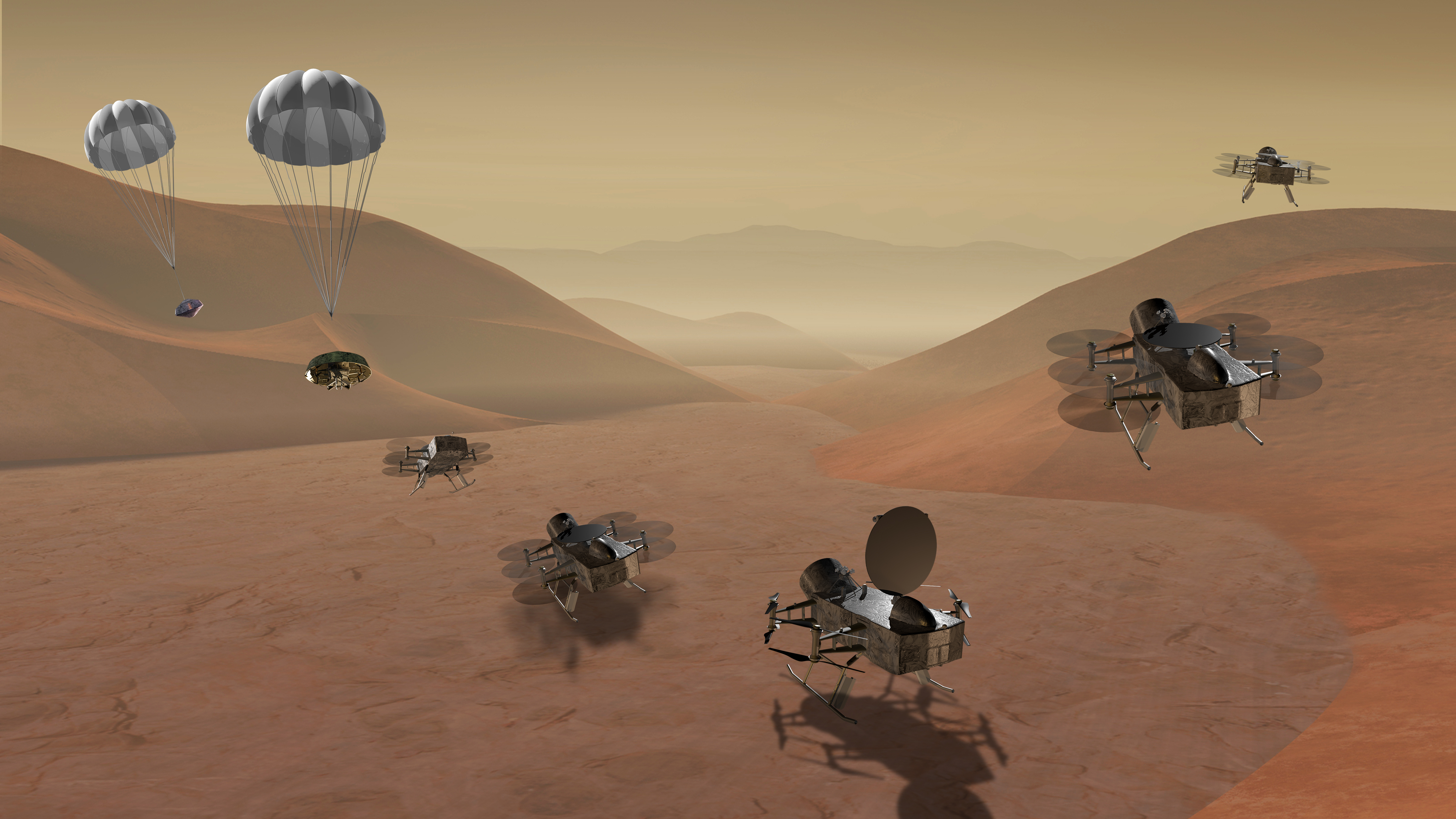
Engineers building NASA's Dragonfly rotorcraft have run the spacecraft's flight software through a complete simulation of the maneuver it will have to perform entirely on its own roughly 900 million miles from Earth: lifting off from the surface of Saturn's moon Titan, scanning the ground below for hazards, and setting itself down again. NASA said in an October 23 mission blog post that the exercise was the most comprehensive rehearsal of Dragonfly's planned "first flight" to date, run in real time on the same flight-like avionics that will fly on the actual vehicle.
The test did not involve any hardware leaving the ground. It took place on a computer testbed at the Johns Hopkins Applied Physics Laboratory (APL) in Laurel, Maryland, where the car-sized, eight-rotor lander is being assembled and tested for a mission to one of the strangest worlds in the solar system.
What the simulation did
According to NASA's account, the virtual Dragonfly lifted off, surveyed the terrain with its sensors, circled back toward a safe site, and began its final descent, all while the onboard software reacted to synthetic sensor data as if it were real. The test fed the flight computer simulated input from the navigation cameras, the inertial measurement units, and the lidar instrument that measures terrain height and slope and flags hazards. A custom graphics-based camera emulator generated the simulated views of Titan's surface that the rotorcraft's cameras would see, rendering each frame at exposure times of roughly 20 to 70 milliseconds to approximate flight conditions.
Zach Putnam, Dragonfly's mobility subsystem lead engineer at APL, described the significance of the maneuver being tested. "It uses every piece of flight sensor hardware on the lander," he said of the first-flight sequence, adding that the team built up to this full test incrementally, beginning with a single spinning rotor, then a short repositioning hop, then a partial scouting flight, adding sensor inputs at each stage.
"The cool thing about first flight is that it's our most challenging flight," Putnam said, according to NASA's mission blog.
Why the rehearsal matters now
The exercise matters because of how far Dragonfly will be from any human help. Radio signals between Earth and Saturn's system take well over an hour one way, which rules out real-time piloting. Putnam noted that once Dragonfly is airborne at Titan, it will have to fly its routes without guidance from controllers on Earth, making autonomous hazard detection and landing-site selection central to the mission's survival. The October test is the clearest evidence yet that the software responsible for that autonomy can run a full flight sequence end to end on the hardware that will actually fly.
The milestone builds on testing APL detailed in a January 2026 release, which described five weeks of full-scale rotor trials in NASA Langley's Transonic Dynamics Tunnel under Titan-like aerodynamic conditions, plus smaller-scale rotor model tests completed in December 2025. Those campaigns were aimed at validating the mechanical side of flight; the October simulation addressed the software and sensor side, specifically, whether the rotorcraft can decide where to land without a human in the loop.
Separately, NASA said Lockheed Martin engineers have been testing the "pose" mechanism that will lower Dragonfly from its stowed position inside the entry capsule's backshell into deployment position after atmospheric entry, including tests at tilted angles to account for the backshell swinging under its parachute.
A mission built around an alien atmosphere
Dragonfly is designed to exploit Titan's unusual combination of thick atmosphere and low gravity, conditions that make powered flight considerably easier there than on Mars or Earth, according to NASA's mission overview. The rotorcraft is intended to fly repeatedly between sites over roughly three years on the surface, examining Titan's dunes and the Selk impact crater to study the moon's prebiotic chemistry. NASA describes the mission's central scientific goal as assessing Titan's habitability and how far chemical processes that precede biology have progressed there, rather than searching directly for life.
Elizabeth "Zibi" Turtle of APL, Dragonfly's principal investigator, has said the team still has substantial work ahead. "There's still much to do between now and our launch in 2028," she said in the January release describing the rotor-testing campaign. NASA's current schedule calls for a launch no earlier than 2028, a cruise of roughly six years to the Saturn system, and arrival at Titan in 2034.
Independent science-news coverage of the October test, including a write-up from the technology outlet TechStock², noted that the camera emulator's frame-rendering times are consistent with what Dragonfly's onboard cameras are expected to use in flight, and that the exercise represented an integrated software rehearsal rather than a physical flight test, a distinction NASA's own post also makes clear.
What comes next
NASA said the Dragonfly team's next step is to repeat the first-flight sequence on the spacecraft's actual flight avionics rather than the ground testbed, and to begin deliberately injecting faults into the simulation to see how the autonomous system responds to problems such as a sensor dropout or an unexpected obstacle. Those fault-response tests are intended to build confidence that the rotorcraft can recover from anomalies on its own, since there is no possibility of a quick course correction from mission control given the communication delay to Saturn.
Formal integration and testing of the full rotorcraft began earlier this year, following the rotor assembly's mechanical qualification. Program officials have not announced a date for completing the flight-avionics version of the first-flight test.

Webb telescope finds dusty ice on interstellar comet 3I/ATLAS, echoing bodies beyond Neptune
Europe's Hera Probe Finally Sees Two Asteroids Where It Once Saw One

Radio Images Show Betelgeuse's Hidden Companion Disturbing the Supergiant's Atmosphere
